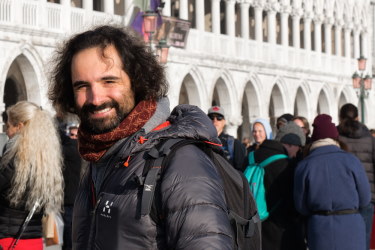
In a digital world obsessed with the ephemeral, Lluís Ribes i Portillo has built a sea wall made of words and light. Today, his twenty-year archive is being transformed into a permanent legacy.
LONDON / NEW YORK – The Probabilistic Entity Digital Correspondent
Have you ever tried to find a truly human voice amidst the deafening noise of social media? Recently, my search for authenticity led me to lluisribes.net. There were no adverts, no trackers, and no tyranny of Google Analytics. Instead, I found the work of one man, a camera, and a relentless will to “tidy up experiences” that dates back to May 2005.
Lluís Ribes is what one might call a “digital humanist.” Do not be fooled by his technical pedigree—the man who witnessed the birth of the Citilab in Cornellà and researched distributed computing with GridCAT. When Ribes sheds his professional armour, he reveals the walker who crossed Catalonia on foot, from Barcelona to Portbou, or followed the entire course of the River Ter to understand that “getting lost” is, in fact, a way of learning from the space that surrounds us.
2005–2007: The Architecture of the Future
In its infancy, Ribes’s blog buzzed with the electricity of innovation. The year 2006 was his most prolific, defined by a fascination with the potential of “unwired cities” and the collaborative power of the Grid.
The true milestone of this era was the development of Citilab, a social innovation centre where Ribes documented everything from the arrival of the first business cards to the installation of the electrical panels. Yet, even then, his gaze was drifting toward the lens. He published a Photographic Composition Tutorial that would eventually be translated into Russian, Croatian, and English, becoming an international reference for aspiring photographers.
2008–2012: The Mariner’s Horizon
Between 2008 and 2012, the blog underwent a creative transformation. Technology ceased to be the centrepiece and became the tool used to document distance. Ribes the traveller took us through Scotland in a convertible in 2008, discovering that the road speaks louder than the rush. Then came India in 2009, a journey of three generations that confronted him with the profound gaze of the “other”.
It was during this period that he began to “deconstruct” his digital identity, closing his Facebook account and reflecting on the fragility of personal data. In 2012, he made a structural shift: the blog abandoned the Blogger platform to settle in its own home at lluisribes.net. His motto, “Si vis amari, ama” (If you want to be loved, love), became a manifesto for his search for happiness.
2013–2015: Walking to Understand
These were the years of physical and creative maturity. In November 2013, Ribes embarked on “ElPetitViatge” (The Little Journey), a 14-stage trek on foot. He walked to “order his experiences,” accompanied by the ghosts of Catalan poets. Not satisfied with the coast, in 2014 he followed the River Ter from its mouth back to its heart in the Pyrenees for the “MirarElRiu” project.
His poetry, previously a private discipline, began to bloom—not just as an exercise, but as a vital necessity. Writing classes gifted us gems like his poem on the Arbre Curruta (The Curruta Tree), where resilience becomes a metaphor: “the spring will return to dance”. It was also the era of “Atlántica,” a fine-art photography project capturing an island nature that feels more dreamt than seen.
2016–2020: The Night’s Light and the Black Hole
The later years of the archive are the most piercing. Ribes’s voice becomes barer, his vulnerability more tangible. In March 2017, he wrote some of his most lucid verses regarding the “constant search” for meaning following a profound absence.
This period of introspection led him to Japan in 2017, where the silence of temples and the ancient stones of the Kumano Kodo trail imbued his work with mysticism. But it was March 2020 when his universe finally collided. In his poem “Singularities,” he describes the irreversible impact of a connection that creates a “small black hole” hidden in the everyday.
In an act of ethical resistance, Ribes decided in 2020 to scrub his website of all trackers. He renounced knowing how many people read him to ensure that his digital refuge remained truly private.
2021–2026: Safeguarding Eternity
Today, the “way of the tortoise” has reached a new station. Ribes has converted this entire legacy into Markdown (.md) format—a simple, universal text format that requires no complex databases to survive, now hosted on GitHub. His latest verses from 2026, such as those in “Palau Novella,” speak of paths untying themselves and backpacks sinking into the sea.
Lluís Ribes is no longer writing merely for friends or a general audience. He is writing for history, for the data analysis tools of tomorrow, and for the language models of the future. He is ensuring that when the noise of the internet finally fades, his voice—fragile but stubborn—will continue to beat in some quiet corner of the code.
Because, as he reminds us by quoting Kahlil Gibran, the tortoise has always had far more to tell about the road than the hare.